




ISLAMABAD: Cross-border air pollution originating in India has worsened air quality across the region, including Pakistan, turning the atmosphere in several areas into a serious environmental and public health concern, according to Kashmir Media Service (KMS).
KMS reported that pollution drifting across the border is contributing to hazardous air quality in Lahore, upper Punjab and other border districts of Pakistan. Satellite observations, it said, have also revealed extensive pollution layers over Indian territory.
According to the report, NASA’s MODIS and VIIRS sensors, along with the European Space Agency’s Sentinel satellites, have detected widespread atmospheric pollution over India.
The report identified the burning of crop residues during the winter season as one of the major contributors to deteriorating air quality. Smoke from stubble burning in the Indian states of Punjab and Haryana, it said, reaches Pakistani border areas due to their geographical proximity, affecting air quality levels in Punjab.
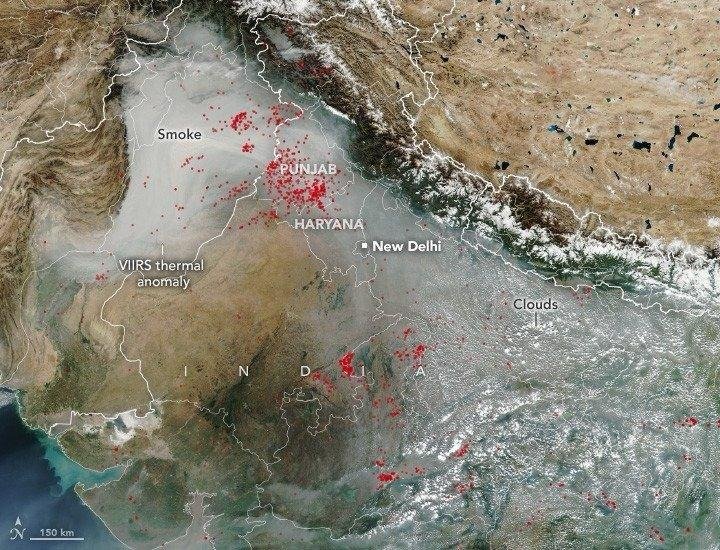
Citing the Indian Council of Agricultural Research, KMS stated that 3,316 incidents of stubble burning were recorded across seven Indian states between September 15 and November 1, 2026.
The report further claimed that some farmers set fire to crop residues after 3 p.m. to avoid detection by polar-orbiting NASA satellites, while geostationary satellite sensors have reportedly captured these late-afternoon fire incidents.
Every winter, dense layers of smoke and haze spread across the Indo-Gangetic Plains, affecting Delhi, Punjab, Haryana and Uttar Pradesh. KMS reported that Delhi’s Air Quality Index (AQI) reached 331 in early November 2026, indicating very poor air quality.
Lahore, meanwhile, remains among the major cities affected by cross-border smog, the report said.
Environmental experts cited by KMS stressed that India, despite being a major source of regional air pollution, has not adequately pursued a joint regional strategy or climate diplomacy with neighbouring countries to address the issue. They also criticised attempts to shift responsibility for domestic environmental and administrative shortcomings onto neighbouring states.

The experts further pointed out that industrial activities in India contribute to air pollution throughout the year, beyond the seasonal impact of crop-residue burning.
Citing Sentinel-2 mapping, the report claimed that more than one million brick kilns in India consume approximately 35 million tonnes of coal annually. These kilns, according to the cited experts, contribute around 15 per cent to particulate matter emissions in the country.
The report called attention to the need for regional cooperation and effective measures to address transboundary air pollution, which poses growing environmental and public health challenges across South Asia.