




PM Shehbaz Sharif Calls for Peace, Diplomacy and Fair Resolution of Global Conflicts at UNGA
UNITED NATIONS, September 26 (APP): Prime Minister Muhammad Shehbaz Sharif has said that Pakistan has chosen the path of dialogue over confrontation, cooperation over coercion, and peace over war, stressing that fair resolutions to conflicts, including those in the Middle East, Kashmir and Palestine, are essential for restoring global trust and achieving lasting peace.
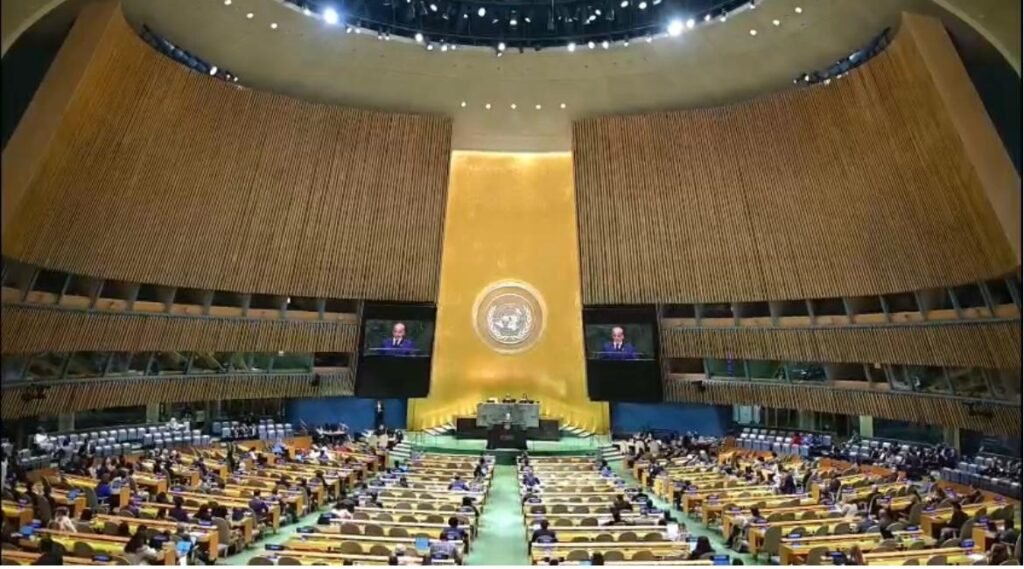
Addressing the 81st session of the United Nations General Assembly (UNGA) on Friday, the Prime Minister said diplomacy must be given a stronger voice amid the growing sound of missiles, drones and guns. He emphasized that the message of peace in the Holy Quran remains a guiding principle for Pakistan and highlighted the country’s diplomatic efforts, including the Islamabad talks.
The Prime Minister said the world was passing through a dangerous period, but the future was not predetermined. “War and peace are both choices,” he said, urging the international community to choose peace for present and future generations.
Quoting Surah Al-Anfal, verse 61, he said: “And if they incline to peace, then incline to it.”
Pakistan-India Tensions and Kashmir
Referring to India’s actions against Pakistan, Prime Minister Shehbaz said Pakistan had faced an unjustified external attack and exercised its right to self-defence under Article 51 of the UN Charter.
He said Pakistan’s armed forces, under the leadership of Field Marshal Syed Asim Munir, responded with professionalism and an effective strategy.
The Prime Minister also acknowledged US President Donald Trump’s intervention, saying it came at a critical moment when the two nuclear-armed neighbours were on the brink of a wider conflict.
He stressed that a fair resolution of the Jammu and Kashmir dispute was essential to prevent South Asia from again reaching such a dangerous situation.
Prime Minister Shehbaz said the Kashmiri people had been waiting for decades for the fulfilment of the promise of a free and impartial plebiscite under the auspices of the United Nations. He reaffirmed Pakistan’s diplomatic, political and moral support for the Kashmiri people’s right to self-determination.
Indus Waters Treaty
On the Indus Waters Treaty, the Prime Minister said India’s decision to keep the agreement in abeyance unilaterally had no legal basis.
He maintained that the treaty remained effective and binding on both sides, citing positions expressed by UN experts and the Court of Arbitration.
Prime Minister Shehbaz warned that water should not be used as a weapon and said any attempt to stop, obstruct or divert Pakistan’s share of water would be regarded by Pakistan as an act of war.
Islamabad Talks and Regional Diplomacy
The Prime Minister highlighted Pakistan’s diplomatic efforts to resolve regional conflicts and said Pakistan had played a role in bringing Washington and Tehran to the negotiating table in Islamabad.
He described the Islamabad talks and subsequent memorandum of understanding as significant steps toward ending the conflict.
He also appreciated the efforts of Field Marshal Syed Asim Munir and Deputy Prime Minister and Foreign Minister Ishaq Dar in creating space for diplomacy.
Calling the Strait of Hormuz and Bab el-Mandeb vital arteries of the global economy, the Prime Minister said these maritime routes must remain open and serve as bridges for trade and prosperity.
Saudi Arabia and Protection of the Holy Sites
Prime Minister Shehbaz strongly condemned attacks by the Houthis against Saudi Arabia and an attempted drone attack targeting Makkah.
He said the security and sanctity of the Holy Mosques in Makkah and Madinah were a red line for Pakistan and that any threat to them was unacceptable.
He described the Makkah Joint Defence Agreement between Pakistan, Saudi Arabia and Türkiye as a collective commitment to regional defence, stability and peace, stressing that it was not directed against any country.
Palestine and Gaza
Speaking about Palestine, the Prime Minister said Palestinians, particularly women, children and the elderly, had faced generations of occupation, displacement and violence.
He reaffirmed Pakistan’s support for an independent, sovereign, viable and geographically contiguous Palestinian state based on the pre-1967 borders, with Al-Quds Al-Sharif as its capital.
He also called for an end to Israeli actions against Lebanon and Syria.
Counter-Terrorism
Prime Minister Shehbaz said Pakistan had sacrificed nearly 100,000 lives and suffered more than $150 billion in economic losses in its fight against terrorism.
He said the sacrifices of Pakistan’s armed forces and civilians should never be forgotten by the peace-loving world.
The Prime Minister alleged that the Tehreek-e-Taliban Pakistan (TTP) and Balochistan Liberation Army (BLA) were operating against Pakistan from alleged safe havens in Afghanistan. He called on Afghan authorities to fulfil their international obligations and take verifiable and decisive measures to prevent Afghan territory from being used against any country.
Islamophobia and Religious Intolerance
The Prime Minister expressed concern over hate speech, discrimination against Muslims, attacks on mosques and incidents involving the desecration of the Holy Quran.
He also referred to what he described as religious hatred and violence associated with Hindutva ideology in India, citing the demolition of a 150-year-old mosque in Saharanpur.
He stressed that there should be no place for religious hatred anywhere in the world.
Pakistan’s Economic Development
Discussing Pakistan’s economy, Prime Minister Shehbaz said economic recovery remained a key responsibility of the government.
He said reforms and fiscal discipline had helped restore economic stability, while efforts were underway to modernize agriculture and industry, develop mineral resources, expand the digital economy and train young people in artificial intelligence and information technology.
He also highlighted the China-Pakistan Economic Corridor (CPEC) and Pakistan’s efforts to strengthen connectivity with the Gulf and Central Asian countries.
Climate Change and Global Economic Reforms
The Prime Minister pointed out that Pakistan contributes less than one percent of global emissions but continues to face severe consequences of climate change.
He called on developed countries to fulfil their climate-finance commitments and provide support for loss and damage, preparedness and recovery in vulnerable countries.
He also called for timely debt relief, appropriate long-term financial assistance and greater representation for developing countries in international financial institutions.
UN Reform
Prime Minister Shehbaz said trust could not be restored through words alone and required practical action.
He called for stronger and more effective United Nations institutions through the “UN80 Initiative” and urged reforms to make the UN Security Council more representative, democratic and accountable.
He said Pakistan’s position was based on the principle: “Reform for all, privilege for none.”
The Prime Minister also congratulated UNGA President Philemon Yang on his leadership and assured Pakistan’s full cooperation. He paid tribute to former UNGA President Annalena Baerbock and UN Secretary-General António Guterres for their contributions to the United Nations and the Global South.
Prime Minister Shehbaz Sharif concluded by emphasizing that diplomacy, dialogue, cooperation and collective action were essential to rebuilding international trust and achieving sustainable global peace.