




By :Syed Manzoor Qaim
ISLAMABAD | DEVELOPMENT & ECONOMY
More than 370,000 households supported under National Poverty Graduation Programme; 108,000 BISP-dependent families reported to have met poverty graduation criteria under PPAF-supported interventions. International conference calls for a national policy to turn temporary assistance into lasting economic independence.
ISLAMABAD: Pakistan’s efforts to combat poverty are gradually shifting from providing financial assistance to enabling vulnerable families to earn sustainable livelihoods, establish small businesses and become economically self-reliant. The Pakistan Poverty Alleviation Fund (PPAF), through its community-based development model and poverty graduation initiatives, has reported significant progress in supporting low-income households, particularly women and rural communities.
The scale of the challenge, however, remains considerable, with poverty reduction requiring more than financial assistance and short-term relief.
According to figures provided by PPAF for media use, 108,000 out of 338,000 households previously dependent on the Benazir Income Support Programme (BISP), representing 32 per cent, have met the criteria for graduating from poverty following PPAF-supported interventions.
The figures offer an indication of how social protection programmes can be connected with economic opportunities to help families move towards financial independence.
From financial assistance to economic independence
The poverty graduation approach is based on the understanding that cash assistance alone cannot provide a lasting solution to poverty. Instead, vulnerable households need a combination of financial support, productive assets, vocational skills, business opportunities and access to markets.
Under this approach, families initially identified through social protection mechanisms receive support according to their economic circumstances. Interventions can include livestock, agricultural equipment, small-business assets, technical training and interest-free loans.
The objective is to enable beneficiaries to establish income-generating activities, increase household earnings and eventually reduce their dependence on welfare assistance.
The National Poverty Graduation Programme (NPGP), implemented from 2017 to 2025 with support from the Government of Pakistan and the International Fund for Agricultural Development (IFAD), provides an important example of this model.
According to the government’s November 2025 assessment announcement, the programme reached 370,567 vulnerable households across 21 districts. It provided productive assets and training to 165,807 families and disbursed 304,324 interest-free loans to 204,760 households.
An independent assessment reported that 56 per cent of beneficiaries had graduated from BISP eligibility criteria, while 80 per cent of supported households had moved out of extreme poverty. The programme also reported the creation of 179,159 jobs and a 48 per cent increase in women’s empowerment.
These results indicate the potential of combining social protection with productive economic support rather than relying exclusively on cash transfers. Pakistan Identity Database +1
Women at the centre of poverty reduction
Women’s economic participation has emerged as one of the significant components of PPAF’s poverty alleviation strategy.
According to the organisation’s figures, women received 60 per cent of the 8.4 million microcredit loans provided through its supported initiatives, benefiting more than five million women.
PPAF also provided PKR 96.5 million in matching grants directly to women-led small businesses, while PKR 61.5 million in commercial bank financing was mobilised for women-owned enterprises that had previously faced difficulties accessing conventional banking facilities.
These interventions are intended to help women establish and expand businesses, generate household income and participate more actively in local economies.
The broader PPAF development model also includes community institutions, skills development, education, healthcare, renewable energy and rural infrastructure.
According to PPAF’s June 2025 fact sheet, its cumulative interventions included 204,200 productive economic assets transferred to vulnerable households, 1.18 million individuals receiving skills and managerial training, and more than 2.67 million households organised through community institutions. Media – Stats.docx +1
International conference seeks a national policy framework
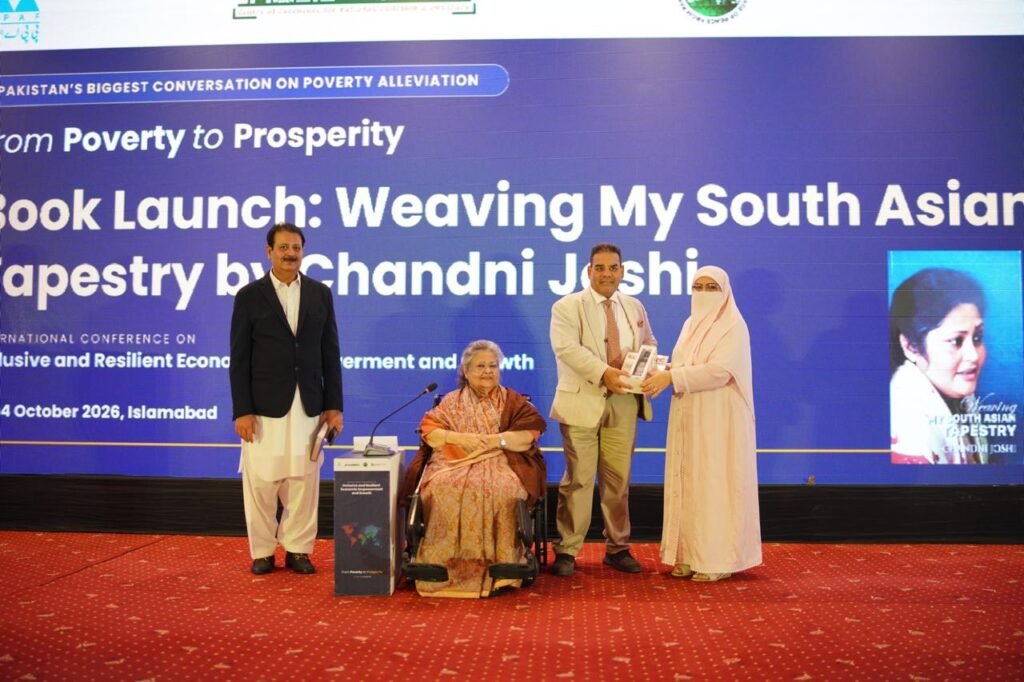
The next phase of Pakistan’s poverty reduction strategy was a central subject of the International Conference on Inclusive and Resilient Economic Empowerment and Growth, held in Islamabad on October 13–14, 2026, under the theme From Poverty to Prosperity.
Organised by PPAF in collaboration with the Ministry of Poverty Alleviation and Social Safety, the Ministry of National Heritage and Culture and other partner institutions, the conference brought together more than 1,000 participants from Pakistan and 12 countries.
The conference concluded with a declaration calling for the formulation of a National Poverty Graduation Policy to establish a coordinated national framework for helping households move from social protection towards sustainable livelihoods.
The declaration identified six major areas requiring coordinated action:
- Poverty graduation and sustainable livelihoods.
- Development of micro, small and medium-sized enterprises (MSMEs).
- Green growth and climate resilience.
- Economic empowerment and employment opportunities for young people.
- Financial inclusion and improved access to commercial financing.
- Sustainable investment, partnerships and development of the cultural economy.
Participants stressed that poverty reduction must be linked with skills development, productive assets, access to finance, business opportunities and market connectivity.
The conference also highlighted the importance of protecting families against economic instability, natural disasters and climate-related shocks that can push previously supported households back into poverty.
A major development during the conference was the launch of PPAF’s Climate Change and Green Growth Strategy 2025–2030, which places community-level adaptation and climate resilience at the centre of sustainable poverty alleviation.
A memorandum of understanding between PPAF and the Centre of National Cohesion and Outreach (CENCO) was also signed to strengthen collaboration around social inclusion, community engagement and national cohesion. PPAF +1
Where does Pakistan stand now?
Despite encouraging programme-level results, Pakistan’s poverty challenge remains substantial.
At the conference, PPAF Chief Executive Officer Nadir Gul Barech highlighted that the country’s poverty rate had increased from 21.9 per cent in 2018–19 to 28.9 per cent in 2024–25.
He also reported that under the National Poverty Graduation Programme, 83.6 per cent of participating households had crossed the basic poverty threshold by 2025, while 57.7 per cent had reached a higher benchmark.
PPAF was operating across 157 districts through 164 partner organisations, supporting more than 171,000 community institutions representing 2.67 million households.
The organisation also reported disbursing 3.69 million interest-free loans since 2014, with 57 per cent going to women and a reported repayment rate of 98 per cent. Pakistan Identity Database
The government has also indicated its intention to extend the poverty graduation model beyond the completed NPGP.
In November 2025, the Ministry of Poverty Alleviation and Social Safety announced plans to scale up the model through an upcoming $132.6 million Islamic Development Bank-supported initiative, titled Poverty Graduation for Extremely Poor and Flood-Affected Households.
However, the October 2026 conference declaration still calls for the formulation of a National Poverty Graduation Policy. Its recommendations should therefore be viewed as a proposed national framework rather than an already implemented policy. Pakistan Identity Database +1
The real test lies beyond the numbers
The results of poverty graduation programmes demonstrate that targeted financial assistance, productive assets, skills training and women’s economic participation can create pathways towards financial independence.
However, the real test is whether families can maintain their income, expand their businesses, access stable markets and withstand inflation, unemployment, illness and climate-related disasters without returning to poverty.
This requires stronger coordination between federal and provincial governments, financial institutions, development partners, the private sector and community organisations.
Addressing the concluding session, Senate Chairman Syed Yusuf Raza Gilani stressed that moving a family out of poverty was only the beginning, while the real measure of success was its ability to build a secure livelihood and remain economically independent.
The conference has provided a policy direction and an opportunity to build on existing programme achievements. Its success will ultimately depend on translating the declaration into a national policy, measurable targets, sustained financing and an effective mechanism to monitor households after they graduate from poverty.
For Pakistan, the challenge is no longer simply to provide assistance to the poorest families, but to create an economic environment in which they can stand on their own feet and remain out of poverty.
Editorial fact-check and important distinction
There are three different sets of figures in the material, and they should not be presented as the same programme result:
Indicator Reported outcome
PPAF media figures: households graduating 108,000 of 338,000 (32%)
NPGP households reached 370,567
NPGP beneficiaries graduating from BISP criteria 56%
NPGP households lifted out of extreme poverty 80%
PPAF loans to women 60% of 8.4 million
The NPGP figures are from a separate programme assessment. The 32% figure is from the additional PPAF media statistics supplied to you. They should not be combined or treated as identical measurements.
:.
SEO package
SEO headline: Pakistan Poverty Alleviation: 108,000 Households Graduate from Poverty as PPAF Pushes National Policy
URL slug: pakistan-poverty-graduation-ppaf-national-policy
Meta description: PPAF reports 108,000 households graduating from poverty as Pakistan’s 2026 international conference calls for a National Poverty Graduation Policy.
Keywords / Tags: Pakistan Poverty Alleviation, PPAF, Poverty Graduation Programme, BISP, National Poverty Graduation Programme, IFAD, Islamic Development Bank, Women Empowerment, Microfinance, Sustainable Livelihoods, Poverty Reduction Policy, Pakistan Economy.
Thumbnail text: FROM POVERTY TO PROSPERITY
Primary sources: PPAF conference press release and media statistics supplied with your request; Pakistan Ministry of Poverty Alleviation and Social Safety; Press Information Department.